


Custom Solutions for Every Need
From architectural design to renovations to custom home building, we can help get you into your dream home.
Get in Touch

BLOG |

Nobody stops and asks the obvious question: Why are nails measured in pennies? And perhaps more puzzling: Why is the letter “d” involved at all?
The answer takes us on a journey through medieval economics, Roman coins, blacksmiths with hammers, and a measurement system that stubbornly refused to die.
The nail sizing system we use today dates back to 15th-century England. At that time, nails weren’t mass-produced in factories. They were hand-forged by blacksmiths one at a time. Because making nails required real labor, they were sold in bundles, typically by the hundred.
Instead of describing nails by their length, people described them by their price.
For example:
Nails that cost 2 pence per hundred were called 2-penny nails.
Nails that cost 6 pence per hundred were 6-penny nails.
Nails that cost 10 pence per hundred were 10-penny nails.
Over time, carpenters shortened the phrase “penny” to just the number, and eventually it became abbreviated with the letter d. Which leads to the next logical question.
The d doesn’t stand for dimension, diameter, or anything construction-related. It actually comes from the word ‘denarius’, an ancient Roman silver coin.

When the British monetary system developed centuries later, it borrowed the abbreviation ‘d’ from the denarius to represent pence. Even in modern times, British currency used £, s, and d for pounds, shillings, and pence.
So when you see a 10d nail, you’re essentially looking at a label that means: “Ten pence worth of nails (per hundred) according to a medieval pricing system”. It’s like labeling lumber based on the cost of sheep in 1400 - It doesn’t make much sense, yet somehow the system survived.
Eventually something interesting happened. Blacksmiths noticed that bigger nails naturally cost more because they required more metal and more labor to make. As a result, the price categories slowly became associated with specific lengths.
Even after nails began being manufactured in factories and pricing changed, the numbers stayed attached to the sizes. Today, the penny system no longer reflects price at all, it simply indicates length.
Here’s what some of the most common nail sizes translate to today:
Penny Size - Nail Length
2d - 1 inch
4d - 1.5 inches
6d - 2 inches
8d - 2.5 inches
10d - 3 inches
16d - 3.5 inches
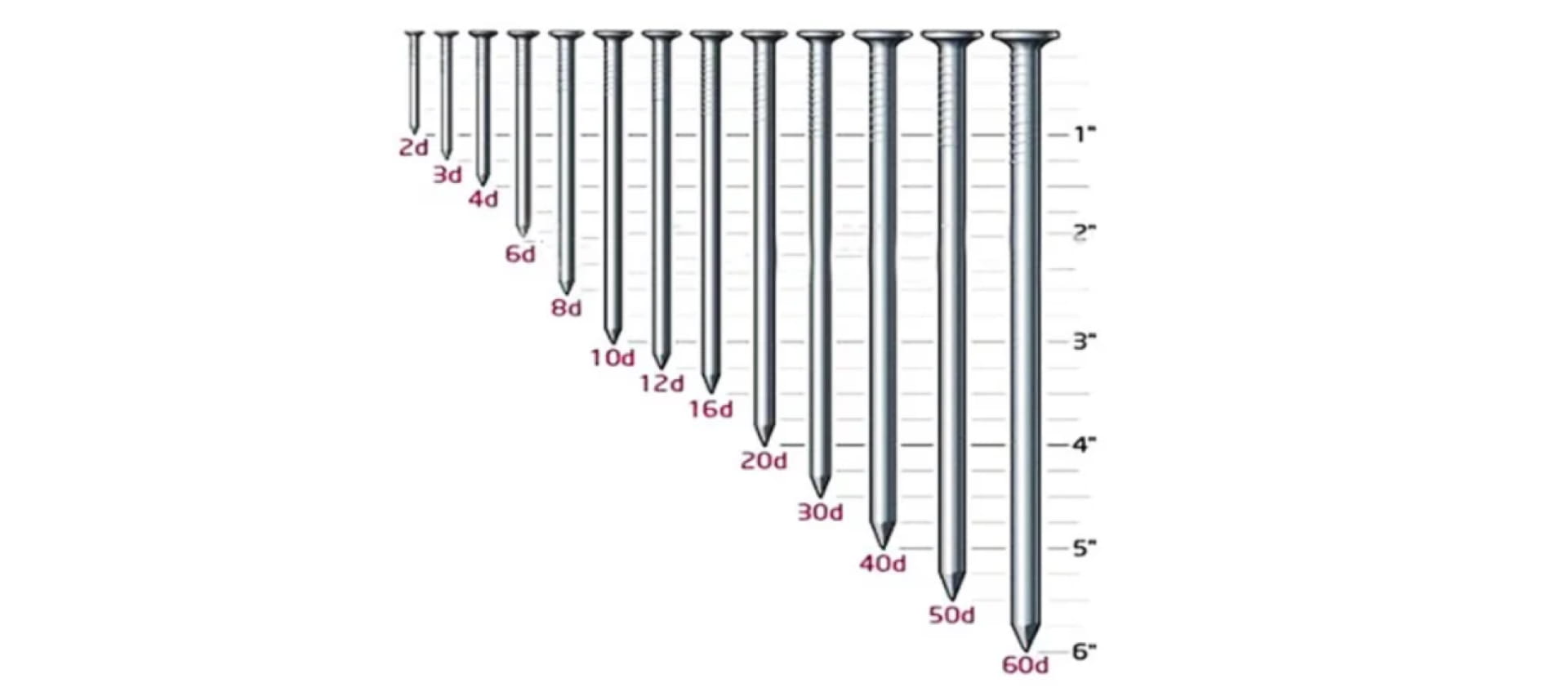
So when a carpenter grabs 16d framing nails, they’re really grabbing 3½-inch nails. But almost nobody calls them that.
At this point you might be wondering: Why not just switch to inches? In theory, we could. But in reality, construction is an industry built on habit and speed. Carpenters learn early on that:
Once a system becomes embedded in trade language, it’s incredibly hard to replace.
It’s the same reason we still measure things in feet and inches, drive cars with horsepower, and store computer files in folders. The terminology sticks because everyone understands it, even if nobody remembers where it came from.
The next time someone grabs a box of 10d nails at Home Depot, they’re unknowingly participating in a system that began over 500 years ago in medieval England.
What started as a simple pricing method for hand-forged nails somehow survived:
Yet carpenters still walk into hardware stores and confidently say: “Yeah, I’ll take a box of 16Ds”. They may not know why the system exists. But thanks to a few Roman coins, some medieval pricing, and centuries of stubborn tradition… the penny nail system is still holding everything together.
Just like the nails themselves.
MORE FROM THE BLOG
From architectural design to renovations to custom home building, we can help get you into your dream home.
Get in Touch
